Where Color Remembers— A Socratic Journey Into Contemporary Abstract Art finds its most vivid expression in the abstract creations of Gregory Christeas. Like Socrates, Christeas does not offer answers — he initiates inquiry. His paintings refuse fixed narratives, compelling the viewer to question perception, meaning, and emotional response.
In Christeas’ abstraction, forms emerge and dissolve much like Socratic dialogue itself: through tension, contradiction, and gradual revelation. The viewer is not instructed but engaged — drawn into an active process of seeing, doubting, and rediscovering. Each encounter becomes a personal dialogue between the artwork and the mind observing it.
In my opinion, this is what makes Christeas’ work distinctly philosophical. His paintings function as visual questions — awakening awareness rather than delivering conclusions — transforming the viewer from passive observer into participant, exactly as Socrates intended with his method of inquiry.
The Parallels Series — Where Color Remembers
Gregory Christeas paints from a life marked by freedom, memory, and the endless horizon of the sea. His abstraction does not describe the world — it reveals the inner life of it.
A celebrated Greek national hero and acclaimed abstract artist, Christeas paints with the memory of resistance, the breath of the Aegean, and the long echo of history moving through him. His life has been shaped by the fight for freedom, exile, return, and the quiet discipline of a man who refuses to forget where he comes from. Even in Paris — when Pablo Picasso looked at his work and said, “Strong — very strong work,” — the sea and the struggle were already present in every line.
The Parallels Series rises from that journey.
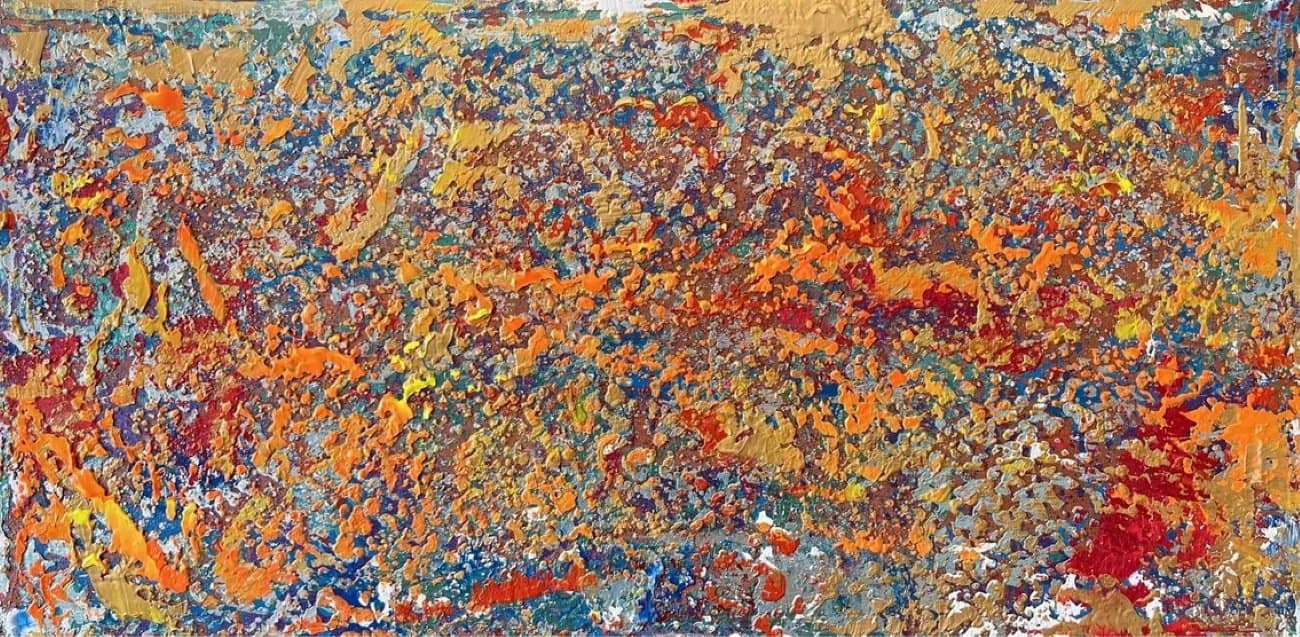
These paintings begin as conversations with color — layers built not to conceal, but to allow what lies beneath to breathe. Metallic tones, shifting light, and luminous pigments are laid down with intention — not in weight, but in rhythm — so the under-layers remain alive, glowing softly through the spaces between lines. Nothing is buried. Everything remains present. The colors coexist like memories layered across a lifetime, still vibrant, still awake.
Look closely and you’ll see it: tone floating over tone, quiet intervals of space, lines that expand and contract like tides.
The parallels do not simply repeat — they pulse. They wander. They hold tension like a question never fully answered. Structure lives beside intuition. Order leans gently against chaos. Time drifts across the surface — past and present folding into one luminous field.
What emerges is not invention — but recognition. These works reveal thoughts born from memory — a lifetime wandering in search of beauty — returning now as color, presence, and breath.
For Christeas, abstraction is the truest picture of human emotion: layered yet open, spontaneous yet reflective. These works do not instruct the viewer — they invite contemplation. They behave like Socratic questions, quietly asking:
“What’s going on?”
The spaces between the layers become places of awareness — thresholds between seeing and knowing.
As the light changes, the metallic and fluorescent tones respond gently — revealing hidden rhythms and deepening presence. The painting becomes less an object and more a living companion in the room — something you return to again and again, because it never stops speaking.
To live with a Christeas painting is to live with an ongoing conversation — like being in the company of an old friend, remembering unforgettable moments. There is a soft echo of sea-light and memory in these works, a quiet undercurrent of courage and tenderness, and the eternal human search for meaning.
And my honest opinion? That is the rarest quality art can hold. These paintings don’t shout — they breathe. They allow mystery to exist. They protect the quiet freedom of not fully knowing — while still feeling everything.
Mystery remains here — and so does beauty.
Agamemnon Varvitsiotis, PHDHellenic Center for Advanced Research in Metaphysics and Philosophy.